
Christian County Date Sources
Christian County has two custody systems in Taylorville. The Christian County Correctional Center is the sheriff’s jail. Taylorville Correctional Center is an IDOC state prison. Similar place names make a wrong-system search easy. County release questions go to the sheriff and sentencing court. State-prison calculations go to IDOC.
| Custody status | Date source | What the date means |
|---|---|---|
| Pretrial county detainee | Court order and sheriff | No fixed sentence-end date may exist |
| Sentenced county detainee | Judgment, mittimus, and jail | County sentence after applicable credit |
| IDOC prisoner | IDOC offender result | Projected parole and projected discharge are separate |
| Parole or MSR | IDOC and PRB | Institutional release occurred, supervision continues |
| Final discharge | IDOC or PRB record | Correctional sentence or supervision ended |
Find Christian County Prison Dates
Use the IDOC Individual in Custody Search for someone sentenced to IDOC or held at Taylorville Correctional Center. The search accepts last name, IDOC number, or date of birth. An IDOC number is the safest key. Match the name, birth details, sentencing county, and location before using the date.
- Confirm that the person entered IDOC rather than serving only county jail time.
- Search by IDOC number, last name, or birth date.
- Open the matching result after checking identity fields.
- Record the exact “Projected Parole Date” and “Projected Discharge Date” labels.
- Save the access date and recheck near the projected event.
- Afterward, verify the accomplished release through IDOC or VINE.
The official IDOC search form shows those search choices.
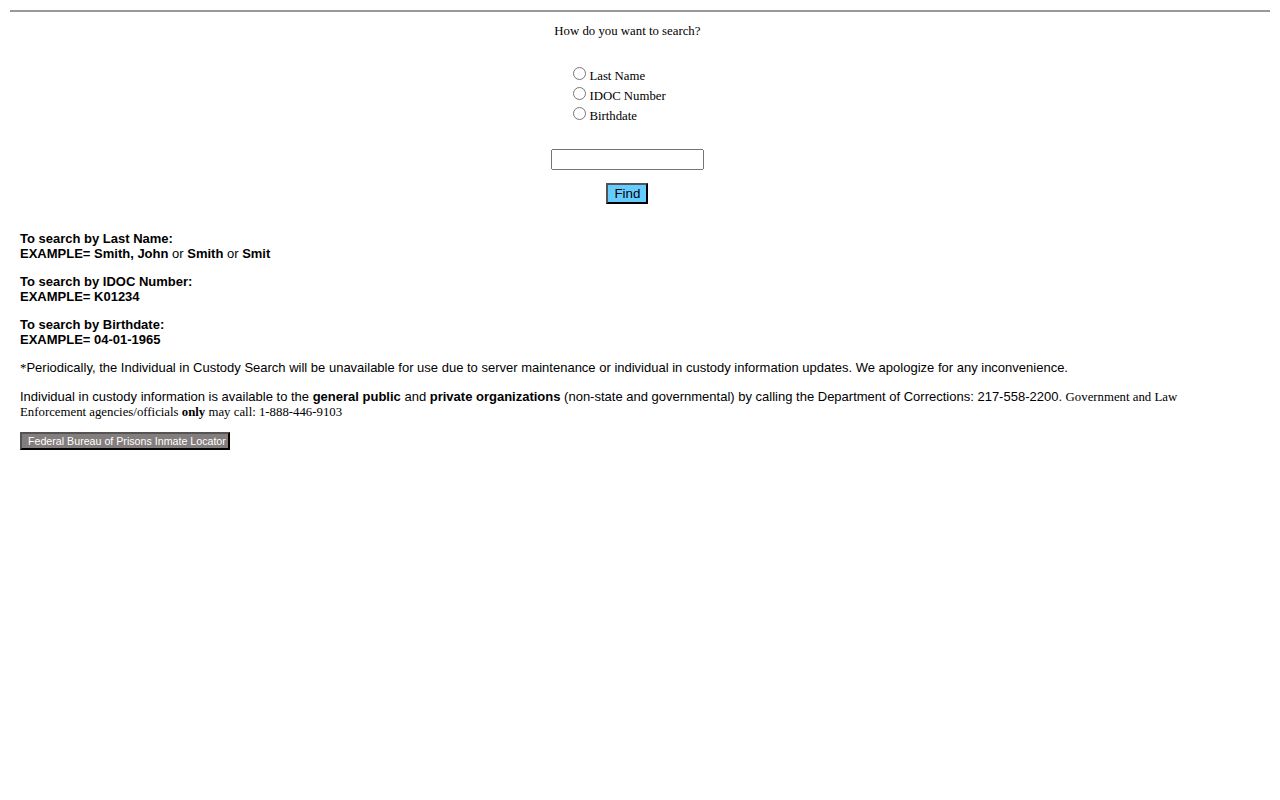
A current location at Taylorville Correctional Center plus a future projected date means the person remains in state custody. Transfer to another IDOC institution changes location, not release status.
Christian County Date Labels
Projected parole date is the anticipated exit from the institution to parole or mandatory supervised release. Projected discharge date is the anticipated end of the correctional sentence or supervision. The two may be far apart. Do not shorten both to “release date,” because that erases whether supervision remains.
| IDOC field | Interpretation |
|---|---|
| Current status | Whether the person is incarcerated, on parole/MSR, or otherwise listed |
| Current location | Institution or supervision placement shown by IDOC |
| Projected Parole Date | Expected institutional exit to state supervision |
| Projected Discharge Date | Expected end of correctional sentence or supervision |
| Admission and sentence data | Context for the IDOC calculation |
IDOC says fully completed sentences can disappear from the live search. Use its contact form with “Record Search” for an archived record. Provide the full name, birth date, approximate admission year, institution, conviction county, and relevant dates. A blank live result after a known prison sentence does not erase that history.
Calculate Christian County Prison Credit
The conceptual IDOC calculation starts with the court term. It then accounts for court-ordered presentence custody credit, statutory sentence credit, authorized earned or program credits, consecutive or concurrent sentence structure, disciplinary changes, court amendments, and detainers. IDOC maintains the operative calculation. A public reader cannot reproduce it reliably from the sentence length alone.
730 ILCS 5/3-6-3 sets Illinois sentence-credit rules. Many listed serious offenses allow no more than 4.5 days of credit per month, often described as about 85 percent service. Certain qualifying drug offenses allow no more than 7.5 days per month, often described as about 75 percent. Other eligible sentences may receive one day of credit per day plus only those additional credits authorized by law and rule. Some categories are stricter.
The offense date, conviction statute, judgment, and current law control. Never apply an 85 percent estimate to every Illinois sentence. Earned discretionary and education or program credits have their own eligibility limits. Completion of a program does not promise an award.
- Sentence credit
- Time deducted under a statute or authorized rule.
- Mittimus
- The court document directing custody and sentence terms.
- Detainer
- A request or hold from another authority that can affect release.
- Concurrent
- Sentences served at the same time.
- Consecutive
- Sentences served one after another.
Christian County Jail Date Rules
County jail dates are separate from IDOC calculations. The County Jail Good Behavior Allowance Act, the judgment, and the mittimus govern sentenced jail time. Pretrial release comes from a court order, not a good-time formula. Call the Christian County jail at 217-824-4961 with the case number and compare the answer with the court sentence.
No verified Christian County source establishes a universal Friday-before-weekend release rule. Release processing follows lawful custody orders and case facts. Avoid moving a date based on customs from another county. The Christian County Judici docket can preserve sentencing, amended-credit, detention, and release-causing orders, but it does not prove the exact moment jail staff completed release.
A pretrial detainee may have no set inmate release date. The next step can depend on a judge’s order, compliance with terms, another hold, dismissal, or case disposition. Ask whether any other agency has a detainer before treating a local release order as freedom from all custody.
Changes to Christian County Dates
Projected dates move for lawful reasons. A change is not by itself an error. Keep the former date, the new date, and each access date when a precise timeline matters.
| Change factor | Possible effect |
|---|---|
| New jail-credit order | Moves the calculation after court review |
| Earned or program credit | May advance an eligible date if awarded |
| Disciplinary loss or restoration | May delay or later restore credit |
| Appeal or amended sentence | Changes the controlling judgment |
| Consecutive sentence or detainer | Can prevent community release on the first date |
| Parole/MSR revocation | Can return the case for recalculation |
| Administrative correction | Updates an earlier data or computation issue |
An approved release plan or host site can also affect institutional exit logistics. That is distinct from the statutory sentence term. Ask IDOC about the current calculation rather than promising release from an old screenshot.
Confirm Christian County Release Dates
Recheck the source close to the date. Then confirm the event after it should have occurred. VINELink Release Check can send a custody-change alert, but VINE does not override IDOC or the sheriff. A delayed alert is possible, and a transfer alert must not be called community release.
For prison release to parole or MSR, confirm the status through IDOC and use Parole / Probation for the supervision distinction. For a county booking, request the sheriff’s release entry with the booking number, release timestamp, authority, and destination. The Christian County release record path explains that request.
When a court order, VINE alert, and corrections result appear to conflict, preserve their exact words. A court order may precede administrative processing. VINE may follow the physical event. IDOC may show MSR while a county arrest page remains online. The originating custodian is the best source for resolving the event.
Christian County Release Plans
A projected institutional exit may depend on more than arithmetic. IDOC release procedures address planning, property, clothing, transportation, and community placement. An approved host site or release plan can affect the practical date on which a person leaves, even when the sentence calculation points to an expected window. That does not let an outside source recalculate the term.
PRB action can also matter. For qualifying parole matters, a grant anticipates planning and conditions but does not certify the actual exit date. A denial, deferral, rescission, or later revocation changes the path. Most modern determinate sentences use MSR instead of an old-law discretionary hearing, so do not promise every Taylorville prisoner a parole vote.
Archive Christian County Date Proof
Projected fields change, and fully discharged records may leave the live IDOC search. Save the exact label, value, source, and access date when a lawful court or records need calls for a timeline. After release, request the accomplished institutional release date, MSR start, and final discharge date rather than relying only on the old projection.
For county custody, ask for the booking sheet and release entry tied to one episode. Include the booking number, admission time, release timestamp, legal authority, and destination. That record distinguishes community release from transport to IDOC, USMS, another jail, or ICE. A date without its status and destination is incomplete.
Christian County Date Requests
When public fields do not answer the question, narrow the request to the responsible custodian. For IDOC, ask for the admission date, institutional release date, parole or MSR start, final discharge, and projected-date history if maintained. Include the IDOC number and Christian County sentencing information. For the sheriff, identify the booking and ask for the release timestamp, legal release type, and destination. Court copies should include the judgment, mittimus, amended credit orders, and any release or detention order. Certification is useful only when the receiving process requires it.
Read these records together. Do not average them into a guessed date. The judgment states the sentence. Corrections applies the lawful calculation. The release entry records what happened. If a projected value differs from the completed event, preserve both and ask whether credit, a hold, an amended order, or administrative processing caused the change.